
Newton, MA · Garage Door Service
What to Know Before You Replace a Garage Door in Newton
See what matters when buying a replacement garage door in Newton, MA, where 1938-1985 housing stock and harsh New England winters shape the right choice.
- Repairs & new doors
- Springs & openers
- Serving 7 nearby communities
What to Check
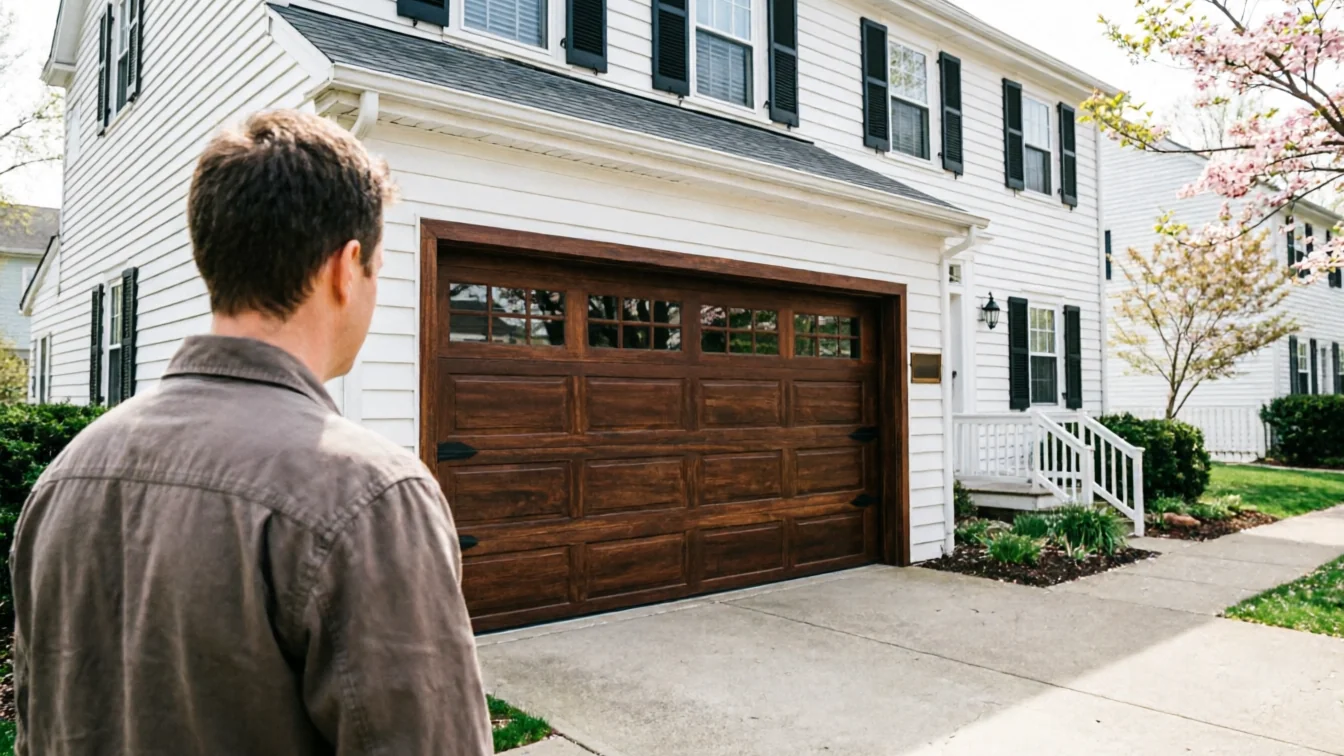
Start with the opening itself, not the door. Newton's housing stock runs mostly 1938 to 1985, with a median build year around 1965, and that range covers a lot of ground across the city's 71 named villages, from Waban to Chestnut Hill to Auburndale. A Cape from 1948 in Newton Highlands has a narrower, shorter rough opening than a split-level built in 1972 near Oak Hill. Measure the actual opening before you shop; don't assume a standard 16x7 fits, because a lot of these garages were framed for the single-car doors common in that mid-century building wave and never resized.
Check the track and header clearance too. Homes from the 1960s and 70s often have low headroom, which rules out some standard torsion setups and pushes you toward low-headroom track or a jackshaft opener. If the house still has its original one-piece swing-up door, the whole frame and hardware are probably original as well, and a straight swap for a sectional door usually means new jamb and header work, not just a new panel.
One honest limitation: we can't tell you what fits from a phone description. A measurement visit before ordering saves a second trip and a door that has to go back.
Season by Season
Newton sits in a cold, severe climate band, and that matters more for a garage door than most people expect. Winter is the season that exposes a weak door: a steel panel with low R-value insulation will let the garage temperature track close to outdoor temperature, which matters if there's a water line, a freezer, or finished space above or beside the garage. If you're replacing a door anyway, this is the point to upgrade insulation rather than match what was there in 1965.
Spring brings freeze-thaw cycling, and that's hardest on a door that's already marginal. Cables and rollers that survived a mild December can give out in March when ice forms overnight on the bottom panel and the opener strains against it every morning. Summer is the easiest season on the hardware, which makes it the right time to plan the swap rather than wait for a January failure.
Fall is worth a weatherstrip check. A worn bottom seal does more damage over a Newton winter than it would somewhere milder, since the cold is sustained, not occasional. If your current door is original to a 1960s build, don't wait for a hard freeze to replace it.
The Situation
Newton's service area includes 234,460 owner-occupied houses among 608,678 households, and median household income here runs $141,440, which is reflected in the kind of doors people choose to put on a house they plan to keep. A lot of replacement work here isn't emergency repair, it's a homeowner upgrading a door that's functionally fine but doesn't match the insulation or style of a renovated house.
Geography plays into this too. Newton sits close to Brookline, Wellesley, Belmont, and Weston, all within a few miles, and a lot of these towns share the same mid-century building wave, so parts availability and door sizing conversations overlap with what you'd face in those places as well. That's useful context, but it doesn't change the measurement work specific to your own garage.
The honest tradeoff: a wider, insulated sectional door costs more up front than patching an old one-piece swing door, but given how many houses here are 50 to 85 years old, patching usually just delays a replacement that's already overdue.
What Local Conditions Do
Cold, severe winters do two things to a garage door over time: they stiffen and crack weatherstripping faster than a moderate climate would, and they put repeated thermal stress on panel seams, especially on doors made before better insulated cores were standard. If your house dates to the 1938-1985 range that covers most of Newton, there's a reasonable chance the door predates current insulation standards entirely.
The other local factor is simply age distribution. With such a concentrated building era across villages like Newtonville, West Newton, and Newton Corner, a lot of garages share the same era-specific quirks: narrow openings, low headroom, and hardware sized for doors that are heavier or lighter than what's sold today. That consistency is actually useful when sourcing a replacement, since the common opening sizes from that era are well understood.
We can't promise a price without seeing the opening and door type you want, but we can tell you upfront that a direct swap is usually simpler and cheaper than a resize, and that resizing is common enough in these older Newton garages that it's worth asking about before you commit to a door style.
Frequently asked questions
Will a new garage door fit my old opening without extra carpentry?
It depends on the house. A lot of Newton homes built between 1938 and 1985 have openings sized for single-car or narrower doors than what's standard today. Some swaps are direct; others need header or jamb framing changed. We measure before quoting so you're not guessing.
Do I need an insulated door in Newton?
Given the cold, severe winter climate here, an insulated door makes a real difference if the garage is attached, has a water line, or sits under living space. It's not mandatory, but for a house in this climate band it's worth the upgrade cost most homeowners end up wanting anyway.
How old is a typical garage door in Newton likely to be?
With most housing in the area built between 1938 and 1965, a lot of original doors are decades past their expected service life, especially one-piece swing-up styles common in that era. If yours hasn't been replaced, it's worth having it checked rather than waiting for a failure.
Is patching an old door ever the right call?
Sometimes, if the panel and track are sound and it's just a seal or roller issue. But on a door that's original to a 1960s or earlier Newton house, patching usually buys a short delay before replacement becomes necessary anyway.
Related garage door services in Newton
More garage door guides
Book garage door service in Newton
Call now or request a quote - tell us what the door is doing and where you are.