
Newton, MA · Garage Door Service
Safety Sensor Drift: A Newton-Specific Problem
Newton's 1938-1985 housing stock and cold-severe winters push garage slabs enough to throw safety sensors out of alignment. Here's what actually causes it and what to check.
- Repairs & new doors
- Springs & openers
- Serving 7 nearby communities
What to Check
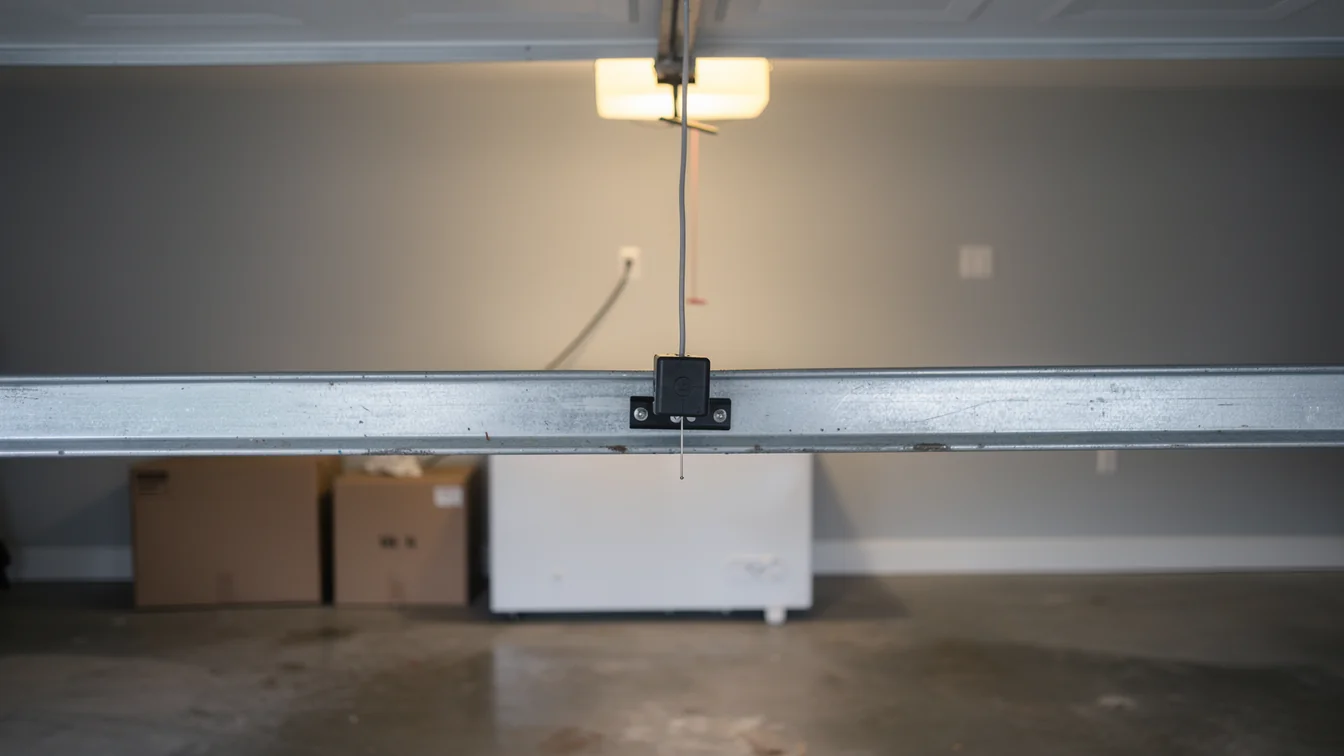
Start at the brackets, not the eyes. The two sensors near the bottom of the track are usually fine as units - what fails is the mount. On a lot of Newton garages, the bracket is a later addition bolted to a slab or jamb that was never built to hold it, because the opener itself predates photo-eye sensors by decades. Look for a bracket that's visibly tilted from true, even a few degrees, since that's enough to break the beam intermittently rather than constantly, which is why the door sometimes reverses for no obvious reason. Check the slab right under each sensor for a hairline crack or a lip where one side sits higher than the other. Wipe the lenses, yes, but don't stop there - if the lenses are clean and the light still blinks, the problem is almost never the sensor itself. On a Newton Center or Newtonville colonial with the original garage footprint, this bracket-to-slab mismatch is the most common call we get, more than a bad sensor unit by a wide margin.
Season by Season
Newton sits in a cold-severe climate band, and that matters more for sensors than for almost anything else on the door. Late fall through early spring, the ground under and around the slab freezes and thaws repeatedly, and the slab itself moves - not dramatically, but enough. A bracket that was square in October can be a few degrees off by February. We see the call volume for "my door won't close all the way" spike every year right around the thaw, not during the hardest cold. Summer brings the opposite movement as the slab expands back, which is why a sensor that drifted all winter sometimes seems to fix itself by July, only to drift again the next freeze. If you own one of the older houses here, built mostly between 1938 and 1985, this isn't a one-time fix - it's a seasonal recheck. We tell owners to glance at sensor alignment twice a year, once after the first hard frost and once after the last one, rather than waiting for the door to start acting up.
The Situation
Newton's housing stock is mostly 1960s and 70s construction, with a median build year of 1965, spread across more than 70 named villages - Waban, Auburndale, Newton Upper Falls, Chestnut Hill, and the rest. Garage doors on those houses were almost never built with sensors in mind. Photo-eye safety sensors became a federal requirement well after most of these garages were framed and slabbed, so what you're looking at on a typical Newton Highlands or West Newton garage is a retrofit: an opener swapped out at some point, with sensor brackets screwed into whatever concrete or wood was there, not engineered for it. That retrofit is usually solid for years. The trouble starts when the original slab, now fifty or sixty winters old, has settled and cracked in ways the bracket was never designed to tolerate. We've opened up more than one Newton Corner garage where the sensor wiring was newer than the garage itself by thirty years, and the bracket mount told the whole story once you looked at the crack underneath it.
What Local Conditions Do
The freeze-thaw cycle is the real driver here. Water gets into hairline cracks in an older slab, freezes, expands, and widens the crack - this is standard for a cold-severe climate, and it's relentless on houses built before 1985 where the original concrete was poured to a different standard than what goes in today. Each cycle nudges the slab a fraction, and the sensor bracket, bolted rigidly to that slab, moves with it while the door track - usually anchored higher, to the jamb or frame - doesn't move the same way. That mismatch is what causes the beam to go out of true. One honest limitation: realigning the sensors fixes the symptom, not the slab. If your garage in Oak Hill or Auburndale is on an old, cracked slab, we can get the sensors aligned and working safely, but if the slab keeps heaving every winter, expect to recheck it again next spring. A full slab repair is a different job and a bigger one, and it's not always worth it if the garage is otherwise sound.
Frequently asked questions
Why does my garage door reverse by itself in winter?
Most likely the sensor beam is getting interrupted by a bracket that's drifted out of alignment, which is common in Newton because older slabs move with the freeze-thaw cycle each winter. It's rarely the sensor unit itself - check the bracket mount and the slab underneath it first.
Is sensor drift worse in certain Newton neighborhoods?
It tracks with house age more than location. Villages with a lot of original 1960s and 70s construction - Waban, Newton Highlands, West Newton, and similar areas - tend to have older slabs and retrofit sensor brackets, which is the combination that causes drift.
Can I fix sensor alignment myself?
Often yes, for a simple tilt - loosen the bracket, re-level it, tighten it back down. If the slab underneath is cracked or uneven, realignment will hold for a while but drift again next freeze-thaw cycle, and that's worth knowing before you call it fixed.
Does sensor drift mean I need a new slab?
Not usually. A cracked or settled slab under one sensor bracket doesn't mean the whole garage floor needs replacing. We realign to the slab as it is. A full slab job only makes sense if the movement is severe enough to affect the door track or frame too.
Related garage door services in Newton
More garage door guides
Book garage door service in Newton
Call now or request a quote - tell us what the door is doing and where you are.