
Newton, MA · Garage Door Service
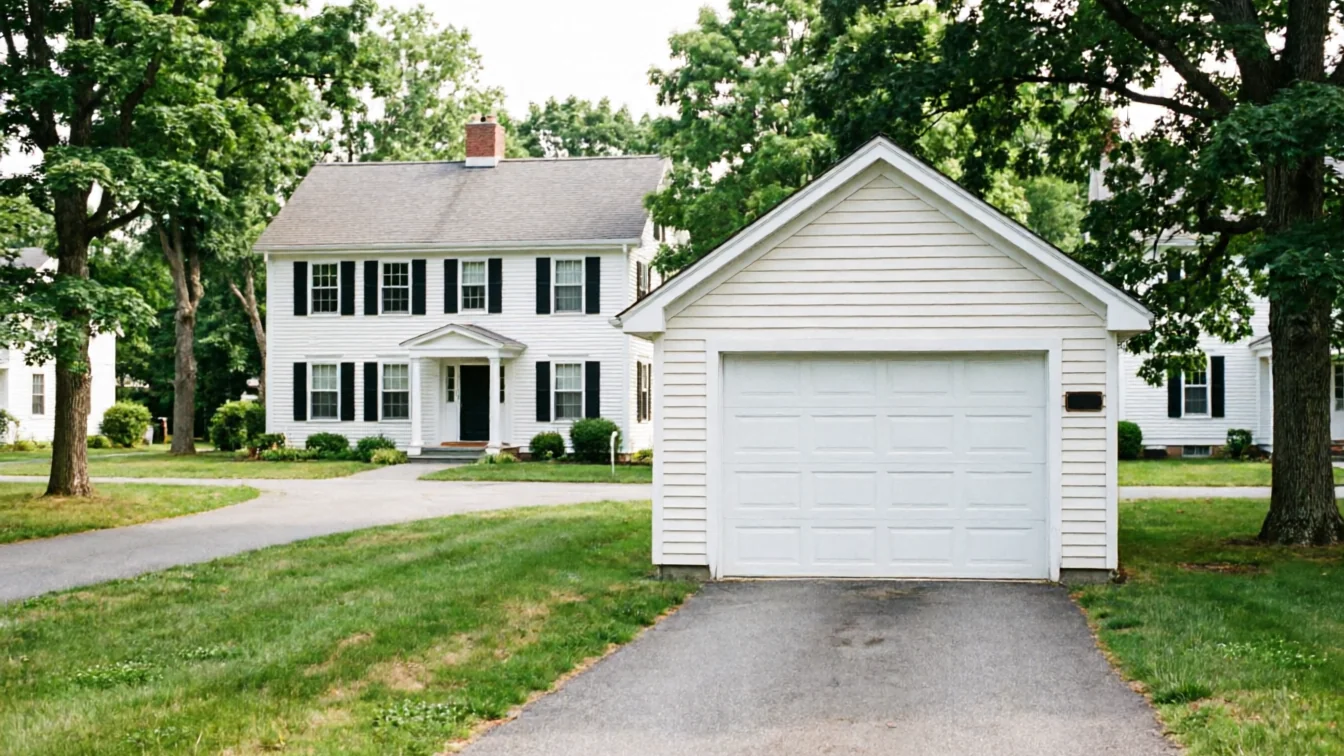
Detached and Attached Garages Need Different Doors in Newton
Newton's housing stock runs 1938-1985, and whether your garage is attached or detached changes what a cold-climate door needs. Here's what to check in each village.
- Repairs & new doors
- Springs & openers
- Serving 7 nearby communities
What to Check
Start with how the garage connects to the house, because that decides what actually fails first. In an attached garage built during Newton's main construction wave of 1938 to 1965, the door shares a wall with living space, so insulation and air sealing around the panel matter as much as the hardware. Check the bottom seal and the weatherstrip along the jambs - if you feel a draft near the mudroom or kitchen that backs onto the garage, the door is pulling cold air straight into the house.
In a detached garage, which is common on the older, narrower lots around Newton Corner and West Newton, there's no shared wall to worry about, but the structure itself has usually had less upkeep. Check the header and track mounts for rot or rust, since detached garages in this area often went up as simple framed outbuildings without the same footing depth as the main house. Look at the spring too - detached units get opened and closed less often, which sounds like less wear, but a spring that sits unused through a Newton winter can seize or lose tension just as fast as one in daily use.
Either way, check the rollers. Newton's housing stock from the 1960s and 70s mostly came with steel rollers that have long since been replaced piecemeal, and mismatched rollers are a common reason a door tracks unevenly.
Season by Season
Newton sits in a cold, severe climate band, and that shows up differently depending on garage type. For an attached garage, the real test is January and February: the shared wall means heat loss through a worn door raises your heating bill and can let condensation form on cold panels, which then drips and rusts the track hardware. Check the seal before the first hard freeze, not after.
For a detached garage, the test is more mechanical than thermal. Without heat bleeding over from the house, the inside of a detached garage in Newton Highlands or Auburndale drops to outdoor temperature overnight, so torsion springs lose a bit of tension in the cold and feel stiffer on the first few openings. That's normal, but it's also when older springs on 1960s-era doors finally let go.
Spring and fall are for the opposite job on both types: checking that the door still seats square after a winter of expansion and contraction in the wood or metal framing, which is common in houses from the 1938-1985 era where the garage opening was framed to older tolerances. A door that rubs on one side in April usually started as a small seasonal shift back in December.
The Situation
Most of the 71 named areas in this service area, from Chestnut Hill to Oak Hill to Nonantum-adjacent streets, were built out during that same long stretch, 1938 through 1985, with the bulk of it mid-1960s. That means a lot of original garage construction here predates modern insulation codes and modern door hardware entirely. Attached garages from that era were framed as an afterthought to the house, so the opening is sometimes slightly out of square, which shows up as a door that binds on one track.
Detached garages from the same period tend to be simpler structures, built without plumbing or finished walls, and often without the structural upgrades the main house received over the decades. A homeowner converting one into usable space will find the door is usually the weakest link - not rated for insulation and not sized to current rough openings.
We don't reframe garage structures or do foundation work. If a detached garage's header is sagging or the opening has shifted enough that no standard door will seat right, that's a carpentry job before it's a door job, and we'll tell you that rather than force a door into an opening that isn't square.
What Local Conditions Do
Cold-climate severity plus an older housing stock is the combination that drives most of the calls we see across Newton's villages, from Waban to Newtonville to Newton Upper Falls. On attached garages, the repeated cycle of freeze and thaw works on the weatherstrip and the bottom seal first, and once that fails, moisture gets into the slab-to-wall joint where the door sits, which can corrode the track bracket over a few winters.
On detached garages, the same cold works more directly on the spring and the opener drive, since there's no adjacent heated space buffering the temperature swing. A detached garage near Newton Lower Falls or Oak Hill will see the same winter night lows as the house eight feet away, but without any residual warmth, so the hardware is effectively left outside.
The practical upshot: an attached door in this area needs good sealing and insulation most of all, while a detached door needs hardware built to handle full outdoor temperature swings without special treatment. Both will show stress from Newton's climate, just through different parts of the system.
Frequently asked questions
Does an attached garage door need different insulation than a detached one in Newton?
Yes. An attached garage shares a wall with the house, so a poorly insulated door raises heating costs and can cause condensation that drips onto hardware. A detached garage doesn't affect indoor heating the same way, so insulation matters less there than having hardware rated for full outdoor cold.
Why does my detached garage door feel stiffer in winter than my neighbor's attached one?
A detached garage has no adjacent heated space, so it sits at full outdoor temperature overnight. Torsion springs lose tension in the cold, and that effect is more noticeable in a detached structure than in an attached garage that gets some residual warmth from the house.
My garage was built in the 1960s - does that matter for door replacement?
It can. Garages from Newton's main construction era, roughly 1938 to 1985, were often framed to older tolerances, so the opening may be slightly out of square. That affects which doors will seat properly without binding on one track.
Can you fix a sagging detached garage so a new door will fit?
No, we don't do structural carpentry or foundation work. If the header or framing has shifted enough that no standard door will seat correctly, that needs a carpenter before a door job, and we'll tell you that up front rather than force an ill-fitting door in.
Related garage door services in Newton
More garage door guides
Book garage door service in Newton
Call now or request a quote - tell us what the door is doing and where you are.