
Newton, MA · Garage Door Service
Openers and Power Outages in Newton Homes
Newton's housing stock runs 1938-1985 and winters hit hard. Here's what that means for your garage door opener when the power goes out.
- Repairs & new doors
- Springs & openers
- Serving 7 nearby communities
What to Check
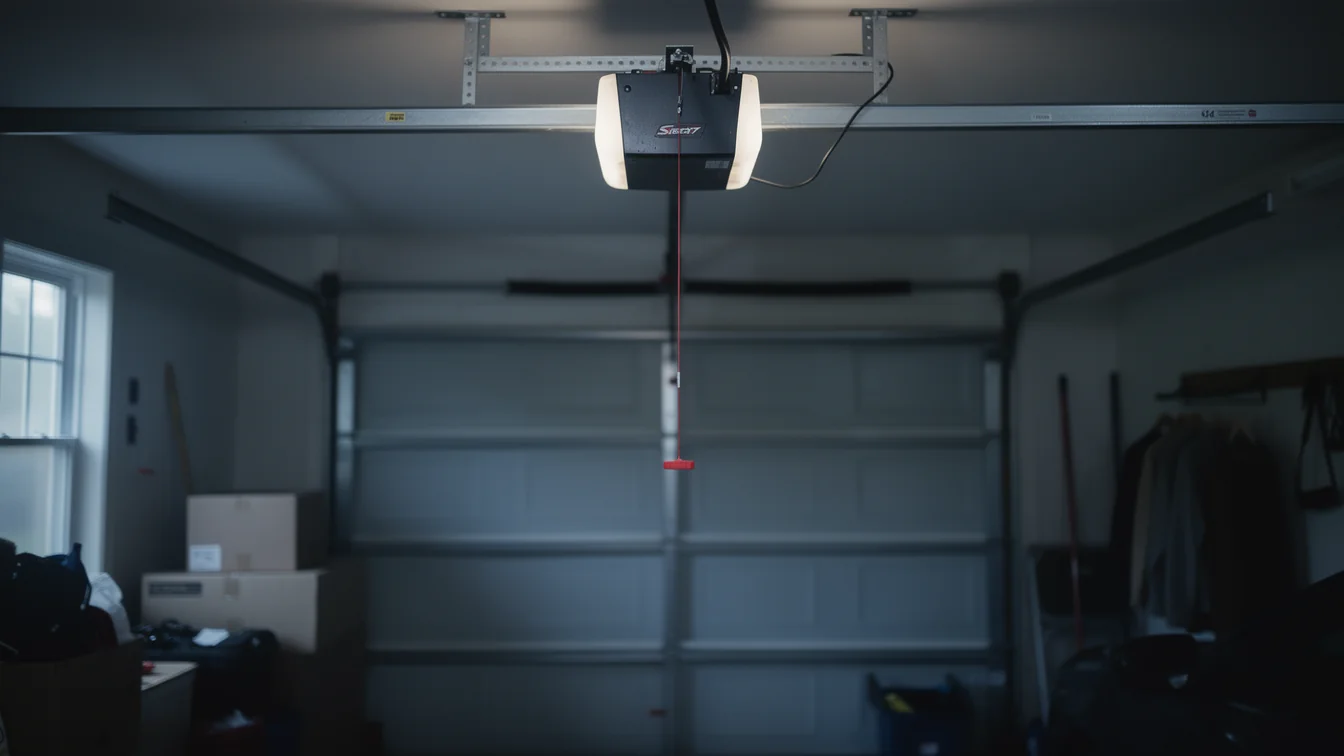
Start with the release cord - the red handle hanging from the trolley on the opener rail. If you've never pulled it, find it now, not during an outage with the car blocked in. On the older openers still running in a lot of Newton's housing stock built between 1938 and 1985, that cord sometimes sits stiff or the trolley has never been disengaged since install. Pull it gently with the door closed; it should release with a firm but manageable tug.
Next, check whether your opener has a battery backup. Units installed since the mid-2000s often do, but a lot of the chain-drive and older screw-drive openers in Newton's 1960s-70s housing predate that feature entirely. If yours doesn't have one, that's worth knowing before a storm, not after.
Look at the wall station too. Older houses sometimes still run a doorbell-style low-voltage wire from decades back, and that wiring doesn't always sit well if a panel upgrade happened without touching the garage circuit. We check this on service calls and it's a common source of 'opener won't respond' complaints that have nothing to do with the motor itself.
Season by Season
Newton sits in a cold-severe climate band, and that matters most in the months when power outages and opener trouble happen together - an ice storm drops a line, and the same cold that caused it is also what's making your opener's gear sprockets stiff and your battery backup (if you have one) run down faster than its rated hours.
In winter, battery backups lose a real chunk of their capacity in cold garages, especially unheated ones attached to the older housing stock common across this service area. Don't assume a backup rated for 20-plus cycles will give you that many on a 10-degree night.
Spring and fall bring their own wear - condensation on steel panels from temperature swings, logic boards that have sat through a winter of power blips and brief brownouts. Summer is the quiet season here: less opener trouble, more time to get ahead of it. If you're going to test your backup battery or swap it out, July does the job better than January, because you'll actually get an honest reading of how it performs.
The Situation
Across this service area - 608,678 households and 234,460 owner-occupied houses spread over 71 named villages and neighboring towns from Waban to Chestnut Hill to Newton Upper Falls - the opener fleet skews older than people expect. Median build year sits around 1965, and a lot of those garages still have the opener that came with a renovation decades ago, not the house's original one, but still well past the age where battery backup was standard equipment.
Median household income here is $141,440, which means when people do upgrade, they tend to go with openers that have battery backup and Wi-Fi status alerts built in rather than the bare minimum. We see a real split: either a 20-year-old chain-drive with no backup at all, or a newer unit installed in the last few years with full battery support. Not much in between.
That split is the actual situation. It's not a town where everyone has the same setup - it's a town where the housing age varies enough that we can't assume anything about your opener until we see it.
What Local Conditions Do
Cold-severe winters do two things to openers during a power outage. First, they slow the backup battery's output right when you need full torque to lift a door that's heavier than usual from cold grease in the track. Second, they make manual operation harder - a door you can lift by hand in July can feel stuck in January even with the opener disengaged, because the springs themselves lose a little tension in deep cold.
In the older end of Newton's housing stock (pre-1970 builds are common per F1/F2), insulation in the garage itself is often minimal, so the opener and any backup battery sit at close to outdoor temperature all winter. That's different from a newer build with a finished, insulated garage, where the same opener holds its rated performance much better.
One honest limitation: a battery backup is not a whole-house generator substitute, and we don't install generators. If your area loses power for days at a time rather than hours, a backup battery buys you a handful of opens and closes, not a week's worth. For longer outages, the manual release and a working memory of where that red cord is matters more than any battery spec.
Frequently asked questions
Will my garage door opener work at all during a power outage?
Only if it has a battery backup, and even then only for a limited number of cycles - fewer in cold weather. Without a backup, you'll need to pull the manual release cord and lift the door by hand. Given how many openers in Newton's older housing stock predate battery backup as a standard feature, check yours now rather than during the next outage.
Does cold weather really affect the backup battery that much?
Yes. Cold-severe winters here mean backup batteries sitting in an unheated garage lose a meaningful chunk of their rated capacity. A battery that handles 20 open-close cycles at room temperature might give you far fewer on a single-digit night, which matters if the power's out and you need the door more than once.
My house was built in the 1960s - is my opener likely outdated?
It's common. A lot of Newton's housing stock dates to the 1960s and 70s, and plenty of those garages still run the opener installed during a later renovation rather than a current model. If yours has no battery backup and no way to check status remotely, it's worth having someone look at whether replacement makes more sense than patching it.
Related garage door services in Newton
More garage door guides
Book garage door service in Newton
Call now or request a quote - tell us what the door is doing and where you are.