
Newton, MA · Garage Door Service
When to Stop Repairing and Start Replacing
A guide for Newton homeowners on when a garage door repair stops making sense, built around the city's 1960s housing stock and New England winters.
- Repairs & new doors
- Springs & openers
- Serving 7 nearby communities
What to Check
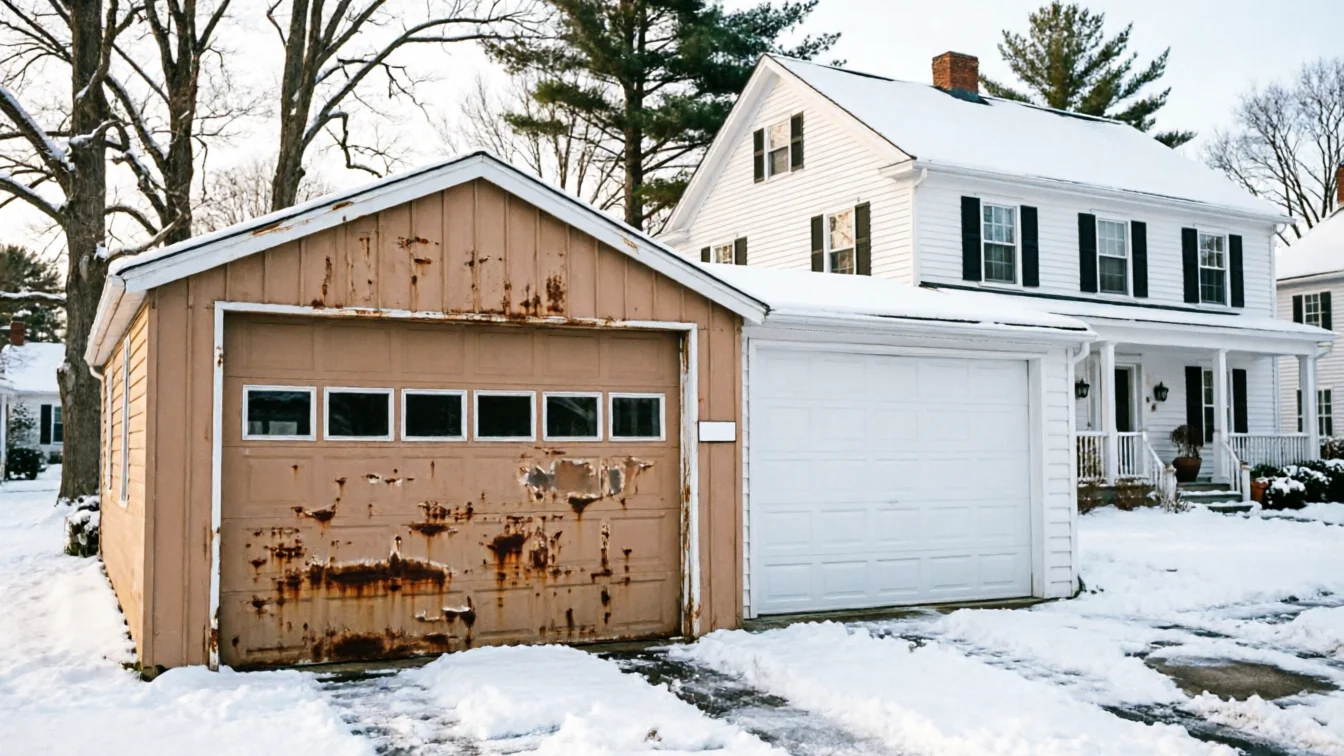
Start with the door itself, not the opener. Newton's housing stock runs mostly 1938 to 1985, with the median build year around 1965, which means a lot of doors and track hardware from an era when galvanized steel was thinner and spring systems were sized differently than what's sold today. If your door is original to a house from that window, check the bottom panel for rust creep along the seams, check the track for play where it bolts to the jamb, and check whether the torsion spring looks like it's been replaced once already or never. A door that's had one spring swap in sixty years and is otherwise sound is worth fixing. A door where the panels are original and the opener has been bolted on three times by three different owners is a different conversation. Look at the rollers too - steel rollers from the original build rattle and bind long before they fail outright, and that noise is often mistaken for a motor problem when it's really end-of-life hardware. None of this is about age for its own sake. It's about whether the parts still match what's on the truck and in the supply chain, because original hardware from a 1965 install often doesn't.
Season by Season
Newton sits in a cold-severe climate band, and that shapes the repair calculus differently depending on when the problem shows up. A spring that's tired in October is worth fixing before the hard freeze hits, because cold steel is brittle steel and a marginal spring that limps through fall can snap outright once temperatures drop and stay down. Late winter is when openers show their age - condensation and repeated freeze-thaw cycling work into motor housings and circuit boards faster than most owners expect, and a board replacement on a ten-year-old opener often costs most of what a new opener costs installed. Spring is when panel damage from winter ice and snow load becomes visible - warping at the bottom panel, hairline cracks at seams - and that's the season to decide whether you're patching a symptom or replacing a door that's taken a structural hit. Summer is the forgiving season here: few emergency calls, which makes it the right time for a planned replacement rather than a panic repair, since you're not racing a freeze or a storm to get the bay closed back up.
The Situation
Newton is made up of 71 named villages and areas, and the housing in each one tends to track the same build era even where the street character differs - a 1965-built door in Waban behaves the same way as a 1965-built door in Auburndale. That consistency actually makes the repair-or-replace call easier: it's less about which village you're in and more about which decade your garage was built in. Across the broader service area there are roughly 234,460 owner-occupied houses among 608,678 households, and median household income sits around $141,440, which matters here because it changes the math on a borderline repair. A $300 spring job on a door that's otherwise sound is an easy yes. A $300 patch on a door with rusted track, an original 1960s panel, and an opener board that's already failed once is money spent to delay a replacement you're going to make anyway within a year or two.
What Local Conditions Do
Cold-severe winters are hard on garage doors in a specific way: metal contracts, lubricant stiffens, and anything already marginal - a spring near the end of its cycle count, a roller with a hairline crack - tends to fail on the coldest morning of the year rather than gradually. That's the pattern worth planning around in Newton: repairs done in fall hold up better than the same repair done in January, because you're not asking tired hardware to perform at its worst right after you've touched it. One honest limitation: we don't carry replacement panels for every original 1960s and 70s door profile, since a lot of that hardware was discontinued decades ago, and matching an existing panel exactly sometimes isn't possible. In those cases the real choice isn't repair versus replace - it's full replacement versus living with a mismatched panel, and we'll tell you that straight rather than quote a patch job we know won't look right.
Frequently asked questions
My door is from the 1960s and still works fine. Should I replace it anyway?
Not on age alone. If the spring, track, and rollers are sound and the panel isn't rusted or warped, a working original door can keep going. The decision point is usually when a second or third component starts failing, not the calendar.
Why did my spring snap in the middle of winter instead of giving warning?
Cold-severe winters make tired steel brittle. A spring that's near the end of its cycle count often holds through fall and then fails on a hard-freeze morning rather than gradually, which is why fall is the better time to replace a marginal one.
Is it worth repairing an opener from the 1990s or 2000s?
Depends what's failed. A sensor or wiring issue is a simple fix. A board or motor failure on an opener that's already had one repair usually costs close to what a new opener costs installed, so at that point replacement is the better call.
Can you match the panel on my original door?
Sometimes not. A lot of panel profiles from houses built in the 1960s and 70s were discontinued long ago. We'll tell you upfront if we can't match yours exactly rather than sell a patch that won't line up right.
Related garage door services in Newton
More garage door guides
Book garage door service in Newton
Call now or request a quote - tell us what the door is doing and where you are.