
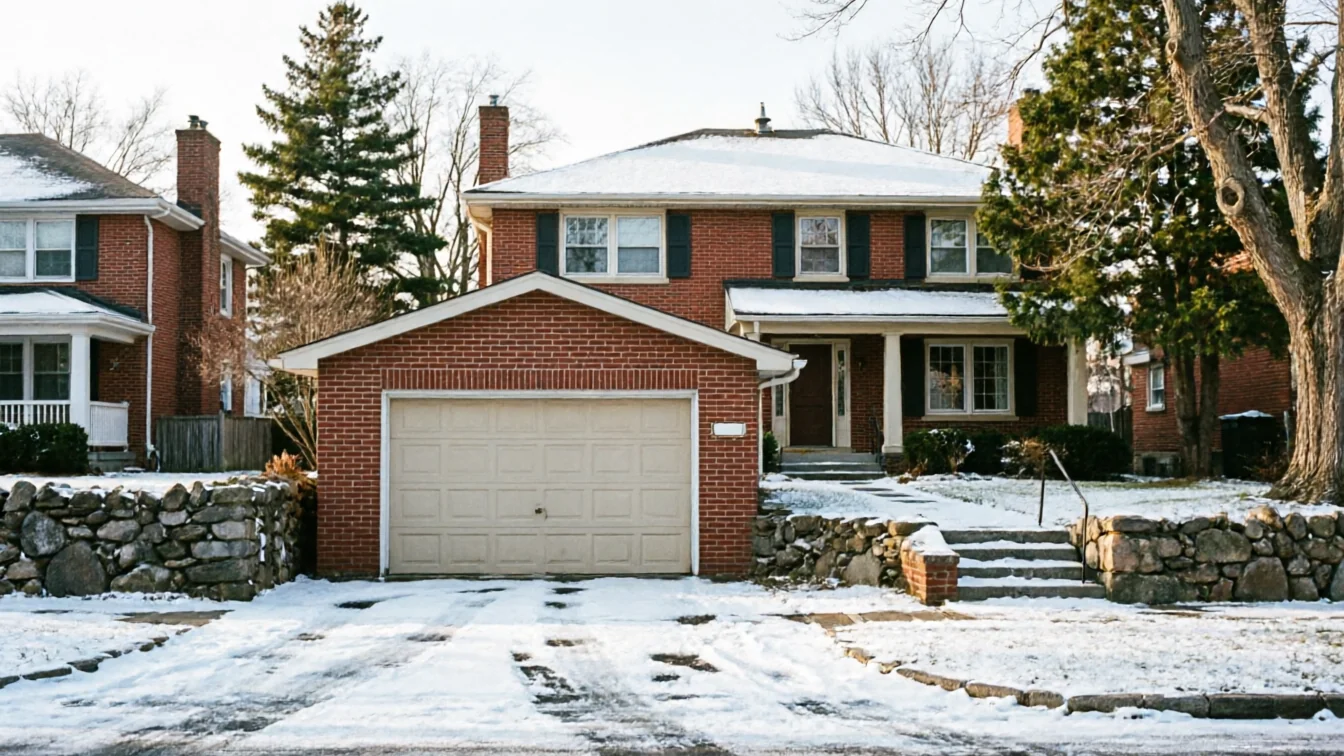
Newton, MA · Garage Door Service
When a Spring Goes in Cold Weather: A Newton Homeowner's Guide
Newton's housing stock dates mostly to 1938-1985 and our winters are brutal on torsion springs. Here's what to check before one breaks on you.
- Repairs & new doors
- Springs & openers
- Serving 7 nearby communities
What to Check
Walk out to the garage before you need to use it, not after. Look at the torsion spring above the door - the thick coiled bar running across the header. A gap in the coil, or one side sitting lower than the other, means it's either cracked or about to be. Don't lift the door to test it; a spring that's partway gone can let go the moment it's loaded.
Check the cable too. Cold makes steel brittle, and a cable that's frayed in August can snap clean in January. Run your eyes down both sides of the door, not just one - springs and cables tend to fail in pairs on older systems because they were sized for a door that's twenty or thirty years lighter than it is now with added insulation.
If your house was built in the decades common across Newton - the 1940s through the 1970s - there's a decent chance the hardware above your door isn't original, but the opening and track dimensions often are. That matters because a lot of torsion springs installed as "universal" replacements in older openings are undersized for what a modern insulated door weighs, and undersized springs are exactly the ones that let go in a cold snap.
Season by Season
Fall is when you want eyes on this, not January. The metal is still workable, parts are easier to source, and you're not standing in a driveway at 10 degrees trying to diagnose a dead spring with a flashlight.
Once real cold sets in - and Newton's winters qualify as severe by the numbers that matter for building and equipment design - steel contracts and loses flexibility. A spring under tension that would have another year of life in May can snap in December because the metal itself is less forgiving at low temperatures. This isn't a theory specific to any one brand of spring; it's physics acting on hardware that was already near the end of its rated cycle count.
Spring is the other pressure point, but for a different reason: temperature swings. A door that sat frozen shut overnight and gets forced open before it's warmed up stresses the same brittle metal. If your spring is going to go, it tends to go at the extremes - the first hard freeze or the first big swing back toward thaw - not in the stable middle of either season.
The Situation
Newton's housing is older than people assume when they're only looking at the house itself and not the garage. Across the city the housing stock runs mostly 1938 to 1985, with a median build year around 1965, and that's consistent whether you're near Newton Center, Waban, Newtonville, or out toward Auburndale and Newton Lower Falls. A lot of those garages still have hardware that's been replaced piecemeal over sixty years rather than as a full system.
That piecemeal history is the real risk. A door panel might be newer, the opener might be ten years old, but the torsion spring could be whatever size was on the shelf the last time someone needed one in a hurry. Mismatched hardware doesn't fail gracefully - it fails at the worst possible moment, which in this city is usually a hard freeze in January.
One honest limit here: we can tell you a spring looks original or looks replaced, but we can't tell you its exact age without pulling the stamp on the coil, and plenty of older springs in this area were never stamped at all. If we can't verify it, we'll tell you that instead of guessing.
What Local Conditions Do
The climate band this part of Massachusetts sits in is classed as severely cold, and that's not just a comfort statistic - it's a load figure building codes and equipment specs are built around. A torsion spring rated for a moderate climate doesn't get a pass here; it gets the same repeated freeze-thaw cycle every winter that houses built in the 1960s were never engineered to shrug off indefinitely.
What that means in practice: the spring doesn't fail because of one cold morning. It fails because of forty winters of cold mornings on a part that was sized for a lighter door and a milder swing in temperature. Garages that face north or stay shaded most of the day hold the cold longer, and we see more failures on those doors than on south-facing ones in the same neighborhood.
If you're not sure which category your garage falls into, the safest move before the next hard freeze is a look at the spring itself, not a guess based on how old the house looks from the street.
Frequently asked questions
Why do springs break more in winter in Newton?
Cold makes steel less flexible, and this area is classed as severely cold for climate and building-load purposes. A spring that's already near the end of its life handles that stress worse in January than in July, especially on homes with original openings dating to the 1940s-1970s stock common across Newton.
Is my spring original to the house?
Hard to say without physically checking the stamp on the coil, and many older springs around Newton were never stamped. We can tell you if it looks original versus replaced based on wear and hardware style, but we won't guess at an exact age we can't verify.
Should I try to tighten or adjust the spring myself?
No. A torsion spring under tension can cause serious injury if it lets go while you're working on it, and that risk goes up, not down, in cold weather when the metal is more brittle. This is one job where the labor cost is worth paying.
Does a north-facing garage break springs more often?
We see it more often, yes. A garage that stays shaded most of the day holds cold longer than one that gets afternoon sun, and that extra cold exposure adds stress to hardware that's already working at the edge of what it was rated for.
Related garage door services in Newton
More garage door guides
Book garage door service in Newton
Call now or request a quote - tell us what the door is doing and where you are.